
Agent Leadership: Why Shipping Software in the AI Era Is a Coordination Problem
AI has fundamentally changed how software gets built.

TL;DR
AI makes starting software projects trivial, but finishing them is now the hard problem.
The bottleneck isn’t code quality — it’s coordination, accountability, and release readiness.
This creates a new role: the Agent Leader, responsible for orchestrating agent teams.
The Release Agent Team models this with six agents (Coordinator, PM, QA, Docs, Security, Release Manager) that enforce a real Definition of Done.
Finishing reliably in the AI era requires better agent leadership, not better prompts.
Starting projects has never been easier. With modern coding assistants, you can spin up a working prototype in minutes. Features, refactors, tests, even documentation drafts appear almost instantly.
And yet—most AI-assisted projects stall.
They don’t fail spectacularly. They just… never quite finish.
This isn’t a tooling problem. It’s a leadership problem.
The AI-Start / Human-Finish Gap
What AI excels at:
Generating code
Suggesting fixes
Drafting tests
Writing documentation
What it struggles with:
Knowing when something is done
Coordinating across domains
Enforcing quality gates
Sequencing work into a real release
So we end up with a familiar pattern:
Code mostly works
Tests are partial
Docs are “TODO”
Security checks are postponed
Releases are delayed or rushed
AI made starting cheap. Finishing became expensive.
Why This Is a Leadership Shift, Not a Productivity Issue
Historically, shipping software was about managing people:
assigning tasks
reviewing work
coordinating handoffs
In AI-first workflows, much of the execution is handled by agents.
The new bottleneck isn’t execution.
It’s coordination, accountability, and definition of done.
This creates a new role that many teams haven’t named yet:
The Agent Leader
An Agent Leader doesn’t write every line of code.
They design the system of agents, define responsibilities, and enforce gates that turn output into outcomes.
Agent Leadership Means Building Agent Teams
One way to think about this is simple:
If you wouldn’t trust a single human to do everything, why trust a single agent?
Real teams specialize. Agent teams should too.
A concrete example of this idea is the Release Agent Team:
https://github.com/grokify/release-agent
It models the release process as a six-agent team, each representing a real-world responsibility.
The Six Agents That Make Finishing Deterministic
1. Release Coordinator
The leader and orchestrator.
This agent doesn’t do the work—it ensures all other agents have passed and sequences the release correctly. Final go/no-go lives here.
2. PM Agent
Defines intent:
scope of the release
semantic versioning
breaking changes
what the release means
Without this, releases drift or become arbitrary.
3. QA Agent
Owns correctness:
builds
tests
linting
runtime checks
This prevents “it works on my machine” from becoming a release.
4. Documentation Agent
Owns clarity:
changelog completeness
release notes
README and user-facing docs
If users can’t understand the release, it isn’t done.
5. Security Agent
Owns safety:
dependency vulnerabilities
license compliance
secret leaks
security posture
Security isn’t a follow-up task—it’s a release gate.
6. Release Manager Agent
Owns mechanics:
git hygiene
CI readiness
version availability
tagging and pushing
This ensures the release process itself is correct and repeatable.
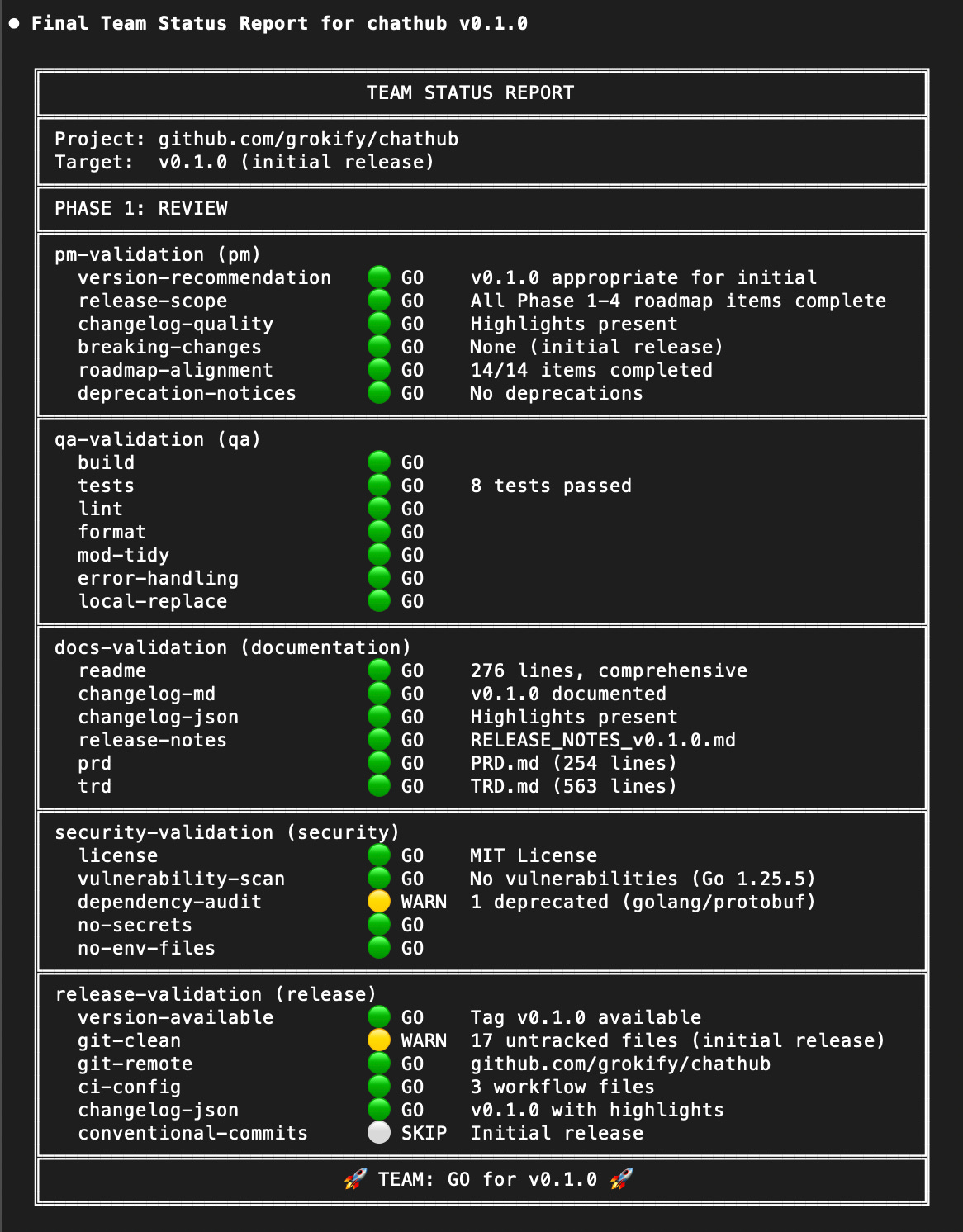
Together, these agents enforce a real Definition of Done.
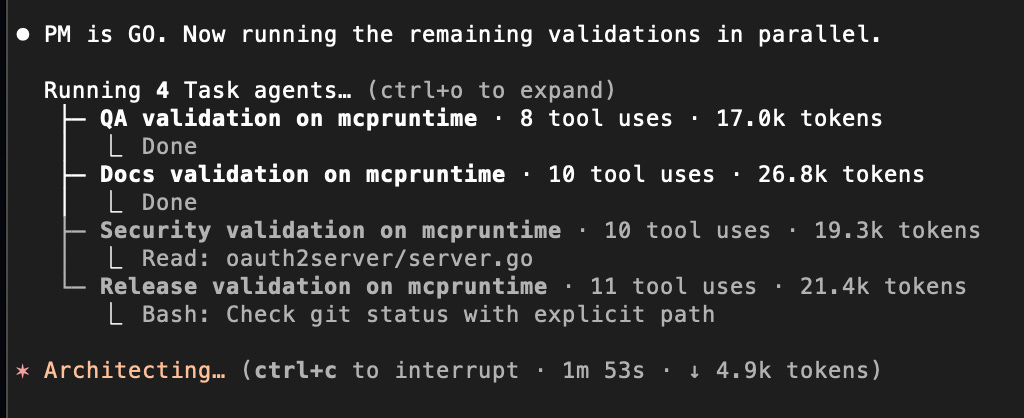
Here are some real examples of team status:
Why This Matters Beyond Releases
The release process is just a starting point.
What this really demonstrates is a pattern:
AI agents are powerful specialists
Specialists need coordination
Coordination requires explicit leadership
This applies to:
product development
research pipelines
infrastructure changes
documentation systems
even non-software workflows
The teams that succeed won’t be the ones with the best prompts.
They’ll be the ones with the best agent architecture.
The New Skill Curve
In the AI era:
Junior engineers learn prompting
Senior engineers learn Agent Leadership
That means:
designing agent roles
defining responsibilities
setting pass/fail criteria
orchestrating workflows
knowing when something is truly finished
The Takeaway
AI didn’t eliminate leadership.
It raised its abstraction level.
The future of software delivery isn’t about writing more code faster.
It’s about leading agent teams that can reliably finish what they start.
If you’re curious what that looks like in practice:
https://github.com/grokify/release-agent
This isn’t the final form—but it’s a glimpse of what Agent Leadership can become.